メールでお問い合わせ :
info@labcompanion.cn
-

-

電話をリクエストする :
+86 18688888286

1. Industry Requirements for High-Temperature Accelerated Lifetime Testing
1.1 Mandatory GR-468-CORE Lifetime Test Criteria
Optical chips, optical modules, and other optoelectronic components must complete standardized reliability qualification before mass production and shipment. The globally recognized industry benchmark is Telcordia GR-468-CORE (Issue 2, 2004), which mandates a minimum service life of 20 years for optical communication devices.
GR-468-CORE categorizes reliability qualification into three core segments: performance verification, stress testing, and accelerated aging testing. High Temperature Operating Life (HTOL) testing serves as the most critical accelerated aging procedure for lifetime prediction.
The standard specifies continuous high-temperature aging at 70°C or 85°C for up to 2000 hours. During testing, key optoelectronic indicators — including optical power, extinction ratio, and receiver sensitivity — require periodic monitoring. Post-test parameter variation must be ≤1.0 dB for general performance tests and ≤1.5 dB for long-term lifetime tests.
Temperature consistency is decisive for valid HTOL results. A 1°C temperature deviation can shift the aging acceleration factor by 15%–20%, directly invalidating lifetime extrapolation data. This places extremely strict precision requirements on test chamber temperature control and stability.
1.2 High-Temperature Failure Mechanisms of Optical Chips and Modules
Long-term high-temperature stress induces predictable, progressive degradation in core optical components. For laser chips, elevated temperatures accelerate defect proliferation and dark-line defect growth, resulting in increased threshold current and decreased output power. Optical modulators suffer quantum well interdiffusion, which distorts electro-optical response performance. For photodetectors, dark current rises exponentially with temperature, degrading receiving sensitivity and signal integrity.
Beyond chip-level degradation, optical modules experience aging failures in packaging materials, solder joints, gold wires, and adhesives under prolonged thermal stress. All failure modes follow the same principle: higher temperature accelerates latent defects. HTOL testing leverages this mechanism to compress decades of field aging into thousands of hours of controlled thermal stress, enabling accurate lifetime evaluation.
1.3 Hierarchical Aging Test Structure from Chip to Module
Optical device qualification adopts a standardized tiered aging workflow to ensure full-link reliability.
Chip-level aging screens defective dies at the wafer and single-chip stage to eliminate early failure units before packaging. Component-level aging verifies packaged devices such as TO-CAN and COS assemblies. Module-level aging performs final full-system qualification on assembled optical modules.
Although each tier requires different chamber capacity and fixture configurations, all tests demand long-duration thermal stability and uniform temperature distribution. Unexpected shutdowns or temperature fluctuations will compromise test repeatability and cause sample loss.
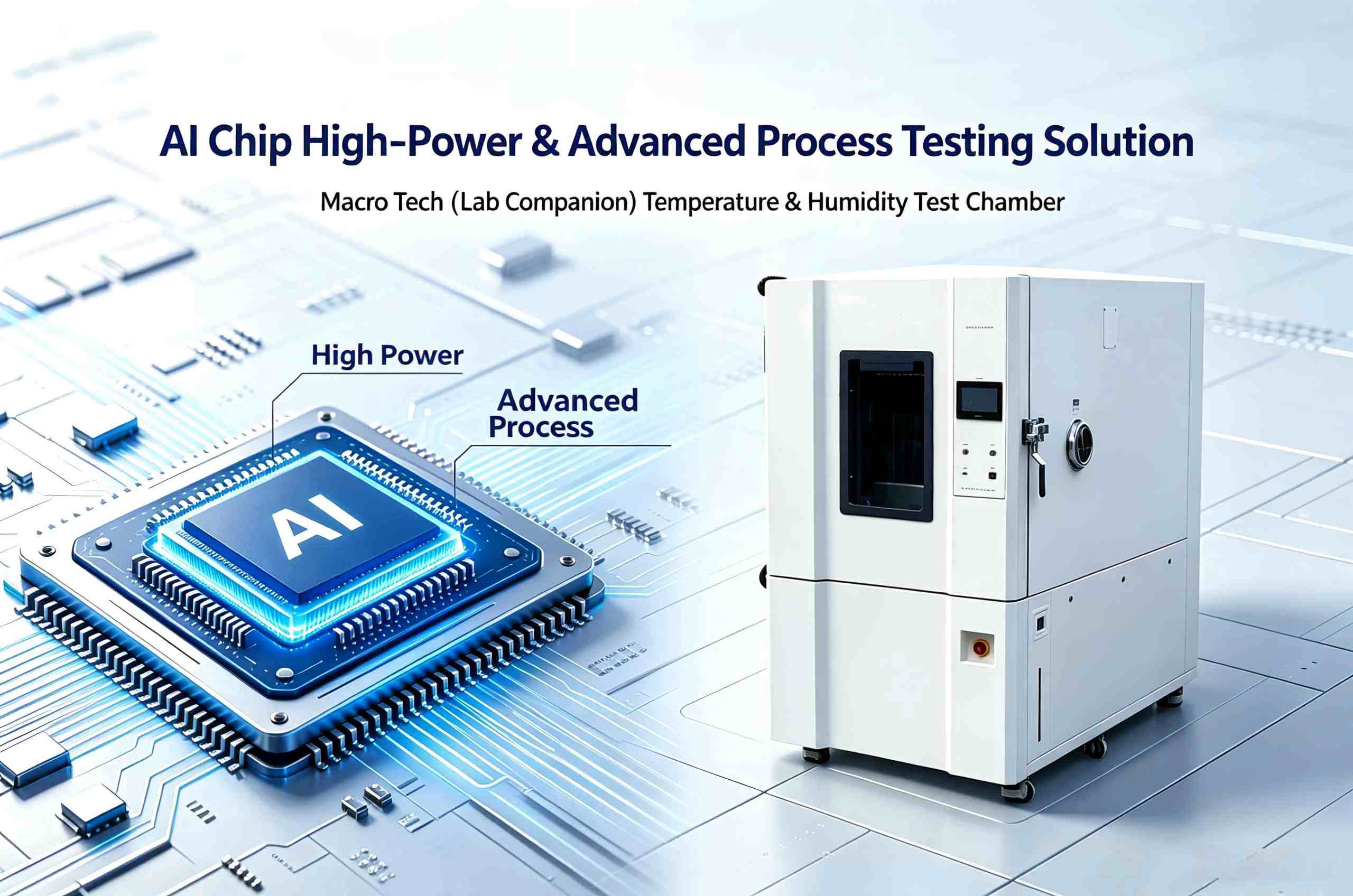
2. About Lab Companion
Lab Companion is a professional manufacturer specializing in environmental and reliability test equipment, serving global high-tech industries including optoelectronics, optical communication, and semiconductors. With standardized R&D and manufacturing bases and a global service network, the brand delivers high-precision, long-life environmental test solutions for industrial qualification and laboratory certification.
Lab Companion’s product portfolio covers high/low temperature chambers, temperature cycling chambers, thermal shock chambers, temperature/humidity chambers, and combined environmental test systems. All equipment is widely deployed for reliability validation of optical chips, silicon photonic devices, and high-speed optical modules.
3. Core Technical Advantages of Lab Companion Temperature Test Chambers
3.1 Wide Temperature Range for Full-Coverage Aging Validation
Lab Companion PS/PG series chambers feature a standard temperature range of -70°C to +150°C, fully covering GR-468 HTOL conditions and multi-scenario qualification requirements:
• High-temperature zone (+85°C ~ +150°C): Fully complies with the 85°C standard GR-468 aging condition and supports elevated-temperature accelerated aging up to 125°C and above.
• Normal-temperature zone (+20°C ~ +85°C): Verifies device performance under standard operating temperature conditions.
• Low-temperature zone (-70°C ~ -40°C): Covers low-temperature storage and cold-condition reliability testing.
Customized extended temperature ranges up to -70°C ~ +180°C are available for special silicon photonics and CPO device requirements.
3.2 High-Precision Temperature Control Ensures Test Repeatability
To eliminate acceleration factor errors caused by temperature drift, Lab Companion equips every chamber with high-precision PID temperature algorithms and CFD-optimized airflow structures. The equipment achieves temperature fluctuation of ±0.5°C and temperature deviation within ±2.0°C.
Adjustable-speed centrifugal fans ensure uniform internal airflow, enabling flexible adaptation to different sample sizes, stacking densities, and test specifications. Consistent thermal field distribution guarantees identical aging stress across all samples, ensuring reliable, repeatable, and certifiable test data.
3.3 24/7 Continuous Operation for Thousand-Hour HTOL Testing
GR-468 requires uninterrupted aging tests ranging from 168 hours to 2000 hours. Lab Companion chambers are engineered for 7×24-hour continuous stable operation to support long-term reliability qualification.
The high-efficiency cascade refrigeration system adopts internationally certified compressors and eco-friendly refrigerants (R404A, R23), maintaining stable cooling capacity across the entire temperature range. Multiple protection mechanisms — including overheating, overcurrent, high/low pressure, and oil heating protection — prevent unexpected downtime.
Corrosion-resistant stainless steel fin heaters deliver uniform and rapid heating, with independent over-temperature protection to secure long-cycle test safety.
3.4 Full-Capacity Product Line for All-Tier Testing
Lab Companion provides a complete range of chamber volumes:34L, 64L, 100L, 180L, 340L, 600L, 1000L, and 1500L. The diversified lineup perfectly matches low-volume chip R&D screening and high-volume module mass production testing.
Equipped with self-developed C100 PID intelligent control system, the chambers support bilingual operation, self-checking, linear temperature/humidity calibration, scheduled startup/shutdown, real-time data trending, and fault logging. Complete data recording functions fully meet international certification and quality traceability requirements.
4. Typical Application Scenarios in Optical Communication Qualification
4.1 Optical Chip Pre-Aging Screening
At wafer and single-chip stages, high-temperature aging screens out early failed dies by continuous 85°C thermal stress for hundreds of hours. Engineers monitor threshold current and output power variation to identify latent defects. Lab Companion 100L and 180L chambers are ideal for chip-level screening, delivering precise and consistent batch-test results.
4.2 GR-468 Full Module HTOL Qualification
Finished optical modules require standard GR-468 aging at 85°C for 500–1000 hours. Lab Companion large-volume chambers (600L–1500L) support multi-batch simultaneous testing to improve mass-production qualification efficiency. Stable 24/7 operation ensures zero interruption during long-lifetime tests.
4.3 Long-Cycle Aging for Silicon Photonics & CPO Devices
Highly integrated silicon photonic and CPO devices demand ultra-long continuous aging up to thousands of hours. Lab Companion optimizes chamber hardware and control logic specifically for high-end integrated optical components, delivering superior stability and reliability for advanced photonic product qualification.
5. Conclusion
GR-468-CORE sets strict standardized benchmarks for optical communication reliability: 85°C continuous aging, up to 2000-hour duration, and maximum 1.5 dB parameter variation. As a reliable global test equipment brand, Lab Companion provides professional HTOL validation solutions covering chips, components, and finished modules.
With -70°C~+150°C wide temperature range, ±0.5°C precise thermal control, 24/7 continuous operation, and full-volume chamber options, Lab Companion effectively eliminates temperature-caused test deviation. It enables optical communication enterprises to perform standardized, repeatable, and certifiable GR-468 lifetime testing, ensuring long-term field reliability of optical chips and optical modules.
 見積もりを依頼する


 IPv6ネットワークをサポート