メールでお問い合わせ :
info@labcompanion.cn
-

-

電話をリクエストする :
+86 18688888286

In the field of environmental reliability testing, rapid temperature change test chambers are core equipment for stimulating potential product defects and verifying environmental durability and service life. Based on different temperature control logic and change modes, mainstream equipment in the industry is divided into two technical categories: linear rapid temperature change chambers and non-linear rapid temperature change chambers. The two types differ significantly in applicable test standards, test scenarios and testing purposes. Distinguishing their technical differences accurately is a core prerequisite for enterprises to implement scientific selection, compliant testing and improved test efficiency.
This article comprehensively analyzes the core differences, applicable scenarios and performance advantages of linear and non-linear rapid temperature change technologies, and elaborates on the technical highlights, parameter strengths and customized solutions of Lab Companion’s two core product series, providing professional and practical selection references for global industrial users.
1. Core Differences Between Linear and Non-Linear Temperature Change Technologies: Trade-off Between Precision Control and High Efficiency Acceleration
1.1 Definition and Principle: Technical Differentiation Between Constant-Speed Precision and Intelligent Variable Speed
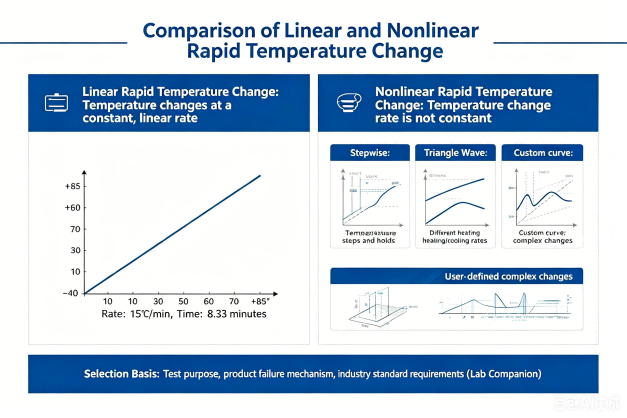
Linear rapid temperature change is defined byfull-process constant-rate temperature rise and fall. Within the set temperature range, the equipment performs temperature changes at a uniform and stable rate, forming a standard straight-line temperature-time curve. Featuring stable control and excellent repeatability, it delivers mild thermal shock to test samples and restores the standard-compliant durability test environment to the greatest extent.
For instance, if the temperature change rate is set to 10℃/min, the equipment maintains this exact rate throughout the test without instantaneous fluctuation, achieving strictly linear temperature variation over time. This technical mode fully complies with constant-rate test requirements of national and international standards, serving as the mainstream solution for conventional reliability qualification tests.
Non-linear rapid temperature change adopts an intelligent variable-speed control logic. Instead of a fixed constant rate, it takes the full-process average temperature change rate as the key assessment index, with adjustable instantaneous rates adapting to test logic, forming a polyline or stepped temperature-time curve.
Focusing on high-stress and high-efficiency testing, this mode simulates complex and harsh sudden temperature changes in actual working conditions, effectively exposing latent defects that cannot be identified via constant-speed temperature cycling. Its core value lies in greatly shortening the test cycle, making it the essential equipment for Highly Accelerated Stress Screening (HASS) and Highly Accelerated Life Testing (HALT), and widely applied in rapid defect detection and mass production screening.
1.2 Application Scenario Differences: Specialized Functions for Precise Test Matching
Designed for distinct testing purposes, linear and non-linear temperature change technologies cover full-scenario testing demands including compliance qualification, durability verification, defect screening and limit testing with clear and complementary application boundaries.
Linear rapid temperature change chambers: Specialize in standardized, high-precision and repeatable testing for conventional reliability verification and product qualification tests requiring constant temperature change rates. Typical applications include automotive electronic durability tests in accordance with ISO 16750, thermal fatigue tests on consumer electronic components and structural materials, as well as compliance inspection and factory qualification tests for military, industrial control and home appliance products.
Non-linear rapid temperature change chambers: Optimized for high-acceleration, high-efficiency and high-stress screening to expose early product defects and verify design limits. Typical applications include high-acceleration defect screening of semiconductor chips per AEC-Q100 standards, mass stress screening of new energy battery modules and electronic control components, limit temperature resistance testing in R&D stages, and accelerated life tests for military products complying with GJB and MIL-STD standards.
2. Horizontal Comparison of Core Technical Indicators
To help users intuitively identify performance differences and quickly match test standards, the core parameters, performance characteristics and applicable specifications of the two types of chambers are compared comprehensively below:
|
Comparison Items |
Linear Rapid Temperature Change Chamber |
Non-Linear Rapid Temperature Change Chamber |
|
Rate Characteristics |
Constant full-process speed, conventional rate: 5~20℃/min with zero obvious fluctuation |
Intelligently adjustable variable speed, max instantaneous rate: 25~30℃/min |
|
Curve Morphology |
Standard linear temperature-time curve with high repeatability |
Customizable polyline/stepped curve for complex variable-speed tests |
|
Control Accuracy |
Ultra-high precision, rate fluctuation ≤±0.5℃/min with excellent data consistency |
Superior accuracy, assessed by qualified full-process average rate |
|
Test Efficiency |
Standard test cycle complying with industrial specifications |
Test efficiency increased by over 40% with prominent accelerated defect screening performance |
|
Applicable Standards |
IEC 60068-2-14, GB/T 2423.22, ISO 1675 and other conventional durability standards |
AEC-Q100, GJB 1032, MIL-STD-883 and other high-acceleration screening standards |
3. Lab Companion Linear Rapid Temperature Change Chamber: Benchmark for Precision Control and Standard Compliance
Lab Companion TC Series Linear Rapid Temperature Change Chambers are flagship products designed for standardized, high-precision and high-repeatability reliability tests. Focusing on constant-speed precision temperature control, traceable data and full standard compatibility, they perfectly adapt to product qualification, durability verification and compliance testing scenarios.
3.1 3D Precision Control System for Zero-Deviation Linear Temperature Change
Abandoning the hysteresis and large deviation drawbacks of traditional single-PID control, the equipment adopts a 3D precision control system consisting of adaptive feedforward control, high-dynamic sensors and balanced thermal system, paired with self-developed dual-PID fuzzy logic algorithm. It compensates in real time for external interferences including load changes, ambient temperature fluctuation and equipment operation loss. The full-process rate fluctuation is strictly controlled within ≤±0.5℃/min, realizing true linear temperature variation. Meanwhile, the chamber temperature fluctuation is ≤±0.3℃ with uniformity ≤±0.5℃, ensuring balanced full-domain temperature field and 100% repeatable and traceable test data.
3.2 Wide Temperature Range & High Load Adaptability with Consistent In-Service Performance
The TC Series covers an ultra-wide temperature range of -70℃~+180℃, fully meeting temperature test requirements for civil, industrial and military products. Equipped with a dual-compressor cascade refrigeration system and graded independent heating modules, it achieves stable loaded linear temperature change at 1~15℃/min with controllable full-process deviation.
Different from the industry’s common empty-chamber parameter exaggeration, all nominal temperature change rates and control accuracy of Lab Companion TC Series are actual measured data under rated heating load, which fully fits real test conditions and eliminates performance attenuation under loaded operation.
3.3 Full Industrial Standard Compatibility for Qualification & Compliance Testing
The series strictly complies with mainstream domestic and international standards including IEC 60068-2-14, GB/T 2423.22 and ISO 16750, fully satisfying conventional reliability tests and official qualification requirements for automotive electronics, consumer electronics, industrial control equipment, precision components and new materials. Equipped with Q8 intelligent touch controller, it supports multi-segment programming, curve preset, one-click start and data storage/export, facilitating standardized daily laboratory testing.
4. Lab Companion Non-Linear Rapid Temperature Change Chamber: Technological Breakthrough for Intelligent Speed Regulation & High-Efficiency Screening
Lab Companion ESS-2000 Series Non-Linear Rapid Temperature Change Chambers are professional devices developed for Highly Accelerated Stress Screening (HASS), Environmental Stress Screening (ESS) and limit life testing. Featuring intelligent speed regulation, efficient defect screening, multi-functional integration and long-term stability, they are ideal for R&D limit verification and mass production batch screening.
4.1 Programmable Intelligent Variable Speed for Shorter Test Cycles & Lower Energy Consumption
Equipped with Lab Companion’s self-developed high-performance multi-channel programmable controller, the equipment supports fully customized non-linear temperature curve editing. Users can set complex working conditions such as multi-segment ramping, constant temperature holding and cyclic temperature change, and precisely control the rate, duration and interval of each segment to simulate complex and harsh actual environmental stresses.
Powered by an intelligent energy consumption regulation algorithm, the equipment adaptively reduces redundant heating power at high temperatures, cutting comprehensive energy consumption by 20% compared with traditional devices while improving test efficiency by over 40%. It effectively exposes latent defects such as virtual welding, structural flaws and material fatigue, greatly shortening product R&D iteration and mass production quality inspection cycles, and achieving optimal balance between test efficiency and production cost.
4.2 Full-Range Rate Coverage with One-Click Linear/Non-Linear Switching
The ESS-2000 Series covers a full temperature change rate range of 1~30℃/min to adapt to all test scenarios: 1~5℃/min for standard conventional temperature cycle tests; 5~15℃/min for mass ESS stress screening of most electronic modules and components; 15~30℃/min ultra-high rate for high-acceleration limit testing.
The equipment supports one-click switching between linear and non-linear modes, integrating standard compliance testing and high-acceleration screening in one unit. It eliminates the need for multiple devices, greatly reducing procurement and site costs and meeting diversified enterprise testing demands.
4.3 Multi-Level Safety Protection for Long-Term Continuous Stable Operation
High-acceleration screening requires long-term uninterrupted operation, making equipment stability and safety critical. The ESS-2000 Series is built with a multi-level intelligent safety protection system, including independent mechanical over-temperature protection, compressor high-exhaust-temperature shutdown, refrigeration system high/low pressure overload protection and water shortage protection, completely avoiding equipment failure and test risks.
In addition, the optimized evaporator structure and intelligent defrost logic extend the continuous operation cycle significantly, reducing shutdown interference caused by defrosting during batch screening. The built-in fault self-diagnosis, real-time status monitoring and acousto-optic alarm system display core component status in real time, enabling early risk prediction and rapid troubleshooting to ensure uninterrupted and efficient testing.
5. Professional Selection Guide & Industry Technology Development Trends
5.1 Targeted Selection Suggestions & Full-Lifecycle Service Support
Core selection principle: Choose linear mode for standard compliance testing; choose non-linear mode for high-efficiency defect screening.
For enterprises focusing on product reliability qualification, compliance inspection and service life verification that require strict standard-based constant-rate testing with high data accuracy, repeatability and authority, the Lab Companion TC Series Linear Rapid Temperature Change Chamber delivers standardized, traceable and high-precision test conditions, perfect for test report issuance, product certification and quality acceptance scenarios.
For enterprises needing R&D limit exploration, mass production batch defect screening and test cycle compression to expose early product defects and verify design and process flaws via high stress, the Lab Companion ESS-2000 Series Non-Linear Rapid Temperature Change Chamber is the optimal solution that balances screening performance and test cost.
Lab Companion provides free technical consultation, free sample testing and customized test scheme design to help customers match equipment with actual testing demands accurately. Custom solutions are available for special test procedures and non-standard industrial specifications. Standard models of the TC Series are in stock for fast delivery, while the ESS Series supports non-standard size customization and walk-in chamber solutions to adapt to diverse production capacities and test requirements.
Supported by nationwide sales and after-sales service networks, Lab Companion offers full-lifecycle services including equipment warranty, remote diagnosis, on-site installation & commissioning, technical training and lifelong maintenance, ensuring reliable equipment operation for global users.
5.2 Industry Technology Trend: Dual-Mode Integration & All-in-One Functionality
Linear and non-linear temperature change technologies are not competitive alternatives but complementary and scenario-segmented technical paths. The linear mode acts as a "precision ruler" to verify conventional product service life reliability and ensure test compliance and data credibility; the non-linear mode serves as a "detection probe" to explore design weaknesses and latent defects while improving test efficiency and product quality.
The global industry is trending toward linear & non-linear dual-mode integration. All-in-one equipment supporting both standard compliance testing and high-acceleration screening effectively reduces enterprise equipment investment and improves test flexibility. With in-depth technical accumulation and rich project experience, Lab Companion continuously iterates dual-mode control technology to optimize equipment accuracy, efficiency and stability, keeping pace with high-end industrial quality development.
Conclusion
In the rapid temperature change testing industry, equipment accuracy, stability and adaptability directly determine the authenticity and effectiveness of product reliability verification. With solid technical expertise, comprehensive product portfolio and mature customized service capabilities, Lab Companion accurately matches temperature testing demands across diverse industries. The TC Series delivers ultra-high precision and standard-compliant stability, while the ESS-2000 Series provides high-efficiency screening and intelligent adaptability. All products feature authentic labeled parameters, stable performance and full-lifecycle professional services, safeguarding product reliability testing for global manufacturers.
For detailed product specifications, parameter comparison sheets, sample testing applications or customized test solutions, please contact the Lab Companion technical team for one-on-one professional support.
 見積もりを依頼する


 IPv6ネットワークをサポート