メールでお問い合わせ :
info@labcompanion.cn
-

-

電話をリクエストする :
+86 18688888286

I. Industry Trends of Ultra-Fast Temperature Change Technology
The iteration of rapid temperature change test chambers is driven by global and Chinese upgrading standards for product reliability testing. Modern testing has evolved from basic high/low temperature storage to professional Environmental Stress Screening (ESS), widely required in China’s semiconductor, military, and new energy industries, forming higher demands for temperature transition speed and stability.
1.1 Updated Global & Chinese Testing Standards
• Past requirements: A temperature change rate of 1~3°C/min was adequate for basic environmental adaptability verification.
• 2026 mainstream standards: The international JESD22-A104 standard requires a minimum cycling rate of 10°C/min. China’s military standard GJB 1032 enforces 100% batch screening for electronic products at 5~15°C/min, raising stricter thresholds for high-reliability manufacturing in China.
1.2 Core Application Value in China’s High-End Manufacturing
Ultra-fast temperature change chambers have become core precision testing equipment in China’s strategic industries:
• Semiconductor industry: Rapid thermal stress exposes latent defects such as package delamination and solder cracking caused by mismatched thermal expansion coefficients.
• Military manufacturing (China): Full-batch rapid temperature cycling ensures equipment stability under extreme operational environments.
• New energy industry (China): Strict thermal shock and temperature uniformity standards guarantee the safety and durability of vehicle power components and electronic systems.
1.3 Three Major Global Technical Bottlenecks
• Cooling capacity limitation: Traditional refrigeration systems decay sharply at low temperatures, causing obvious rate lag in the final cooling stage.
• Temperature uniformity constraint: High-speed airflow easily disrupts chamber temperature consistency, challenging structural and duct design.
• Energy efficiency imbalance: Overlapping operation of heating and refrigeration systems causes energy conflict and temperature fluctuation.
II. Top 10 Manufacturers Performance Evaluation & Market Pattern
The global market features international high-end brands and fast-rising Chinese domestic manufacturers. This evaluation adopts four authoritative dimensions based on China’s industrial application standards.
2.1 Four Core Evaluation Dimensions
• Full-process stability of linear and non-linear temperature change rates
• Chamber temperature uniformity and batch testing repeatability
• Rate retention performance under 25% volume copper block heavy load
• Long-term operational stability (over 20,000 working hours)
2.2 Market Comparison: Imported Brands vs. Chinese Domestic Brands
Advantages & Disadvantages of International Brands
• Strengths: High precision (±0.3°C accuracy, ≤±2.0°C uniformity) and stable long-term performance.
• Weaknesses: 3–5 times higher pricing than Chinese domestic models; agent-based after-sales leads to slow response and long spare-part cycles in China’s Yangtze River Delta.
Core Competitiveness of Lab Companion (Shanghai, China)
• Full rate coverage of 5~25°C/min, with ±0.3°C precision and -70°C~180°C ultra-wide temperature range.
• Temperature uniformity outperforms China’s national standard GB/T 5170.
• Pricing is only 50%~70% of imported equipment with equivalent performance.
• Local Shanghai service center supports rapid after-sales response for Yangtze River Delta enterprises.
2.3 Industry-Leading Practical Performance
Lab Companion solves the common low-temperature rate lag problem. With self-developed AI algorithms and Q8 control system, the equipment maintains ≤±2°C uniformity and ≤±0.5°C fluctuation under full load, and recovers preset temperature within 3 minutes after door opening, ranking top among China’s mainstream manufacturers.
III. Core Technology Advantages of Lab Companion (Shanghai, China)
3.1 Independent Two-Stage Cascade Refrigeration System (China Proprietary)
• Dual-stage cooling structure: High-stage R404A eco-friendly refrigerant for pre-cooling; low-stage R23 refrigerant for stable ultra-low temperature output down to -70°C.
• Stable heat dissipation: Complete compression–condensation–throttling–evaporation cycle ensures sufficient cooling capacity at extreme low temperatures.
• High-efficiency heating & airflow: High-power nichrome heating tubes plus optimized Chinese localized duct design realize stable 5~20°C/min linear temperature change.
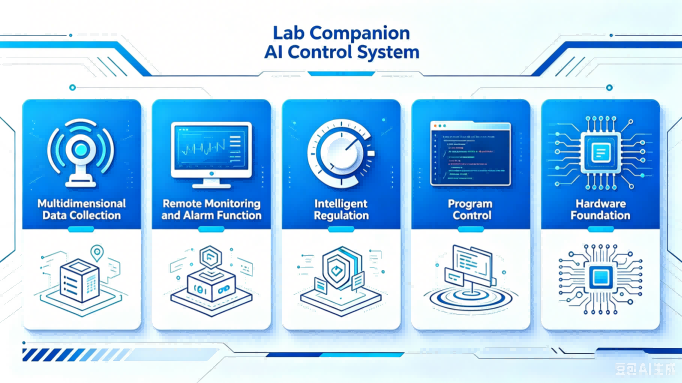
3.2 Q8 Intelligent Control System & AI Dynamic Regulation
• Real-time monitoring of chamber temperature, sample surface temperature and thermal load changes.
• H-PID dynamic balancing technology predicts thermal inertia interference and adjusts compressor and heater output intelligently.
• Temperature overshoot strictly controlled within 0.5°C.
• Overall energy consumption reduced by 28% compared with traditional imported control solutions.
3.3 China Localized Customization & Full-Cycle Service System
• Customization capability: Supports 36L–10,000L non-standard chambers, max 25°C/min ultra-fast rate, and special working condition adaptation.
• Shanghai local service: Dedicated engineer team + local spare parts warehouse, achieving 2-hour rapid response.
• Service advantage: Direct official service far exceeds agent-based support of international brands, ensuring stable operation for Chinese manufacturing clients.
IV. Practical Application & User Cases in China
4.1 Case 1: Automotive-Grade Semiconductor Testing (Shanghai, China)
A Shanghai-based automotive chip verification enterprise adopts Lab Companion 15°C/min linear rapid temperature change chambers.
• Achieves ±0.1°C high precision and ≤±1.5°C temperature uniformity.
• Effectively identifies micro cracks and hidden packaging defects in BGA structures.
• Shortens batch testing cycle by 40% and increases latent defect detection rate by nearly 20%.
• Accelerates new chip R&D launch and accumulates reliable screening data for China’s automotive semiconductor industry.
4.2 Case 2: Chinese Leading New Energy Vehicle Manufacturer
A major new energy vehicle enterprise in China’s Yangtze River Delta uses Lab Companion equipment for BMS controller ESS testing at 10°C/min (-40°C~125°C cycling).
• Completes more thermal cycling tests within the same R&D cycle than traditional low-rate chambers.
• Exposes hidden risks such as cold solder joints and power module thermal fatigue failure.
• Reduces early product failure rate and lowers production line quality supervision pressure.
V. Conclusion
The upgrade of temperature change technology from 5°C/min to 30°C/min represents a systematic innovation of China’s environmental testing equipment industry, covering material science, thermal management, and intelligent control algorithms.
As a benchmark Chinese manufacturer, Lab Companion (Shanghai, China) thoroughly breaks three major industry bottlenecks through independent cascade refrigeration hardware and AI dynamic control algorithms. Supported by China-based localized customization and full-cycle after-sales services, the brand delivers high-precision, cost-effective, and stable rapid temperature cycling solutions.
Lab Companion continuously empowers reliability testing for China’s semiconductor, new energy, military, and automotive electronics sectors, promotes domestic substitution of high-end testing equipment, and provides reliable technical support for global high-end manufacturing.
 見積もりを依頼する


 IPv6ネットワークをサポート